Please cite:
Serizay J, Matthey-Doret C, Bignaud A, Baudry L, Koszul R (2024). “Orchestrating chromosome conformation capture analysis with Bioconductor.” Nature Communications, 15, 1-9. doi:10.1038/s41467-024-44761-x.
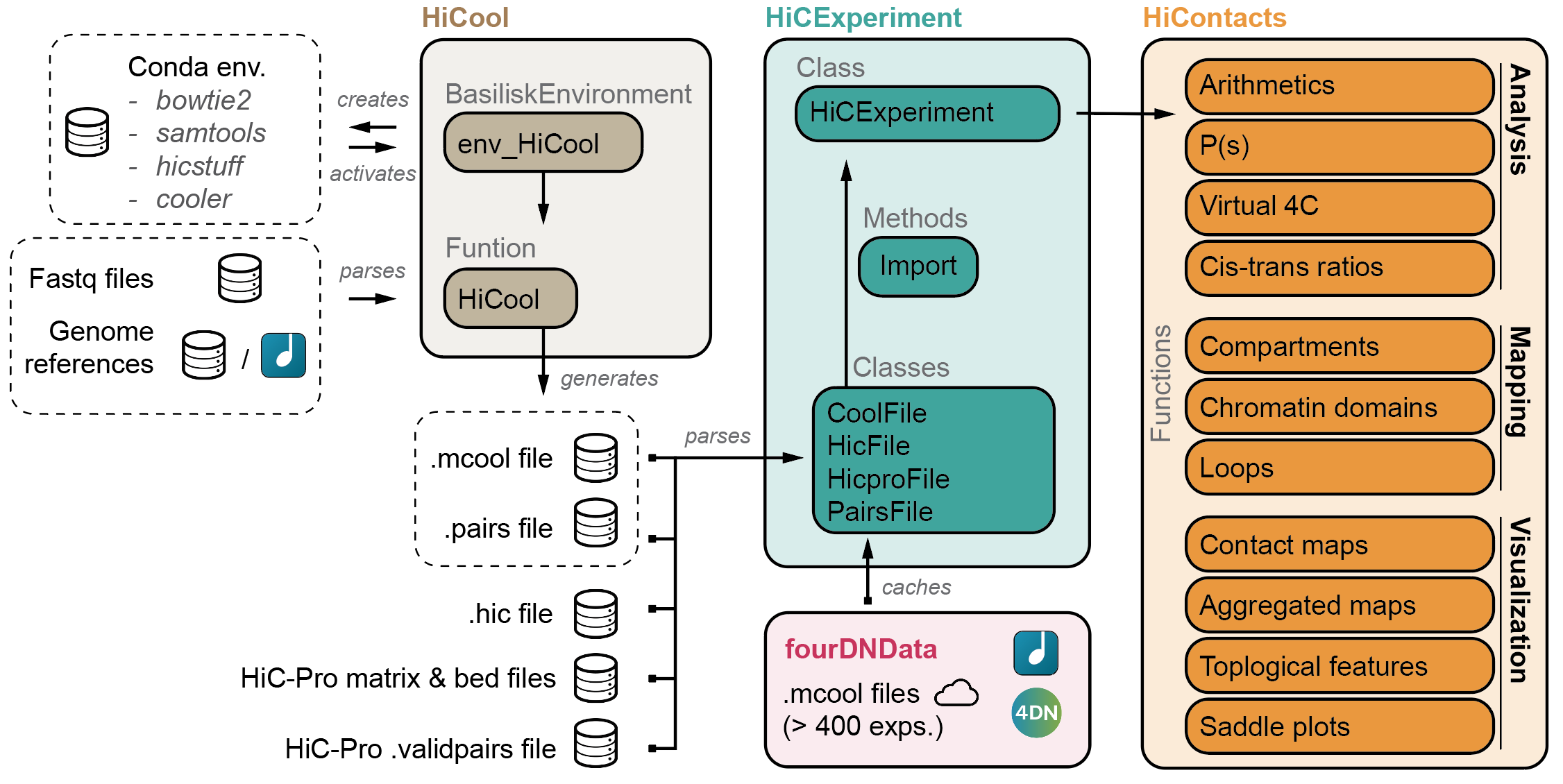
The HiCool R/Bioconductor package provides an end-to-end interface to
process and normalize Hi-C paired-end fastq reads into .(m)cool files.
hicstuff python library
(https://github.com/koszullab/hicstuff).hicstuff.Cooler (https://github.com/open2c/cooler)
library is used to parse pairs into a multi-resolution, balanced .mcool file.
.(m)cool is a compact, indexed HDF5 file format specifically tailored
for efficiently storing HiC-based data. The .(m)cool file format was
developed by Abdennur and Mirny and
published in 2019.basilisk.utils conda environment.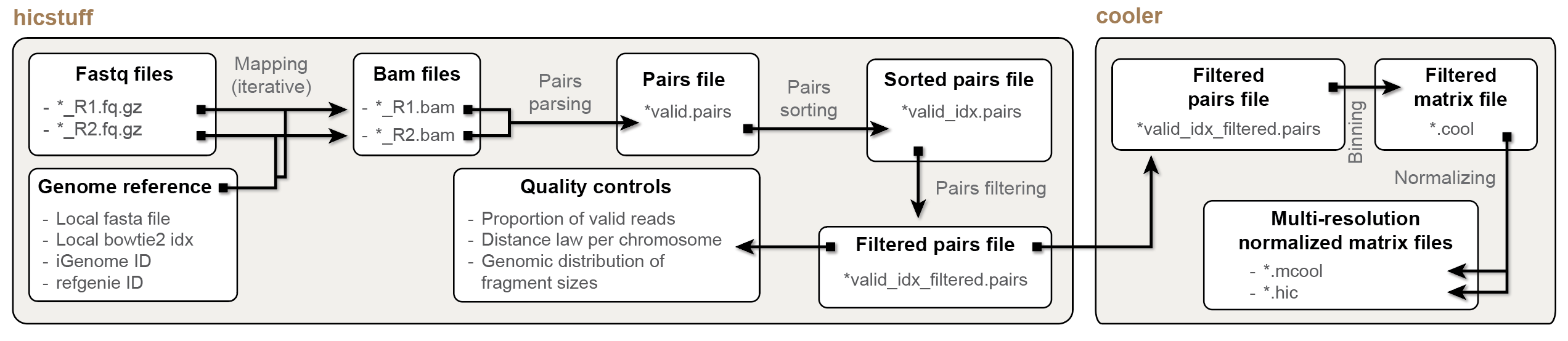
.fastq paired-end files into a .mcool Hi-C contact matrixThe main processing function offered in this package is HiCool().
One simply needs to specify:
.fasta sequence, a pre-computed bowtie2 index
or a supported ID (hg38, mm10, dm6, R64-1-1, WBcel235, GRCz10,
Galgal4);library(HiCool)
x <- HiCool(
r1 = '<PATH-TO-R1.fq.gz>',
r2 = '<PATH-TO-R2.fq.gz>',
restriction = 'DpnII,HinfI',
genome = 'R64-1-1'
)
## HiCool :: Recovering bowtie2 genome index from AWS iGenomes...
## HiCool :: Initiating processing of fastq files [tmp folder: /tmp/RtmpARIRQo/DZ28I8]...
## HiCool :: Mapping fastq files...
## HiCool :: Best-suited minimum resolution automatically inferred: 1000
## HiCool :: Remove unwanted chromosomes...
## HiCool :: Generating multi-resolution .mcool file...
## HiCool :: Balancing .mcool file...
## HiCool :: Tidying up everything for you...
## HiCool :: .fastq to .mcool processing done!
## HiCool :: Check /home/rsg/repos/HiCool/HiCool folder to find the generated files
## HiCool :: Generating HiCool report. This might take a while.
## HiCool :: Report generated and available @ sample^mapped-R64-1-1^DZ28I8.html
## HiCool :: All processing successfully achieved. Congrats!
x
## CoolFile object
##   .mcool file: sample^mapped-R64-1-1^55IONQ.mcool
##   resolution: 1000
##   pairs file: sample^55IONQ.pairs
##   metadata(3): log args stats
## HiCool/
## |-- sample^mapped-R64-1-1^55IONQ.html
## |-- logs
## |   |-- sample^mapped-R64-1-1^55IONQ.log
## |-- matrices
## |   |-- sample^mapped-R64-1-1^55IONQ.mcool
## |-- pairs
## |   |-- sample^mapped-R64-1-1^55IONQ.pairs
## `-- plots
##     |-- sample^mapped-R64-1-1^55IONQ_event_distance.pdf
##     |-- sample^mapped-R64-1-1^55IONQ_event_distribution.pdf
On top of processing fastq reads, HiCool provides convenient reports for single/multiple sample(s).
x <- importHiCoolFolder(output = 'HiCool/', hash = '55IONQ')
HiCReport(x)
As an R/Bioconductor package, HiCool should be very easy to install. The only
dependency is R (>= 4.2). In R, one can run:
if (!require("BiocManager", quietly = TRUE)) install.packages("BiocManager")
BiocManager::install("HiCool")
The first time a HiCool() function is executed, a conda environment
will be automatically set up (with basilisk.utils). In this environment,
few dependencies will be installed:
HiCool is integrated within the HiCExperiment ecosystem in Bioconductor.
Read more about the HiCExperiment class and handling Hi-C data in R
here.